Wikipedia has an in-depth article on the Chinese Communist Party's use of the phrase "hurting the feelings of the Chinese people" in their official communications. However, the graph on the page only runs until 2014, which is when Horng-luen Wang's paper from which it was sourced was published. What does the history look like since then? I asked Claude to come up with a way to grep the archives of the People's Daily and I have totals up to 2026-09-26.
First, our updated graph:
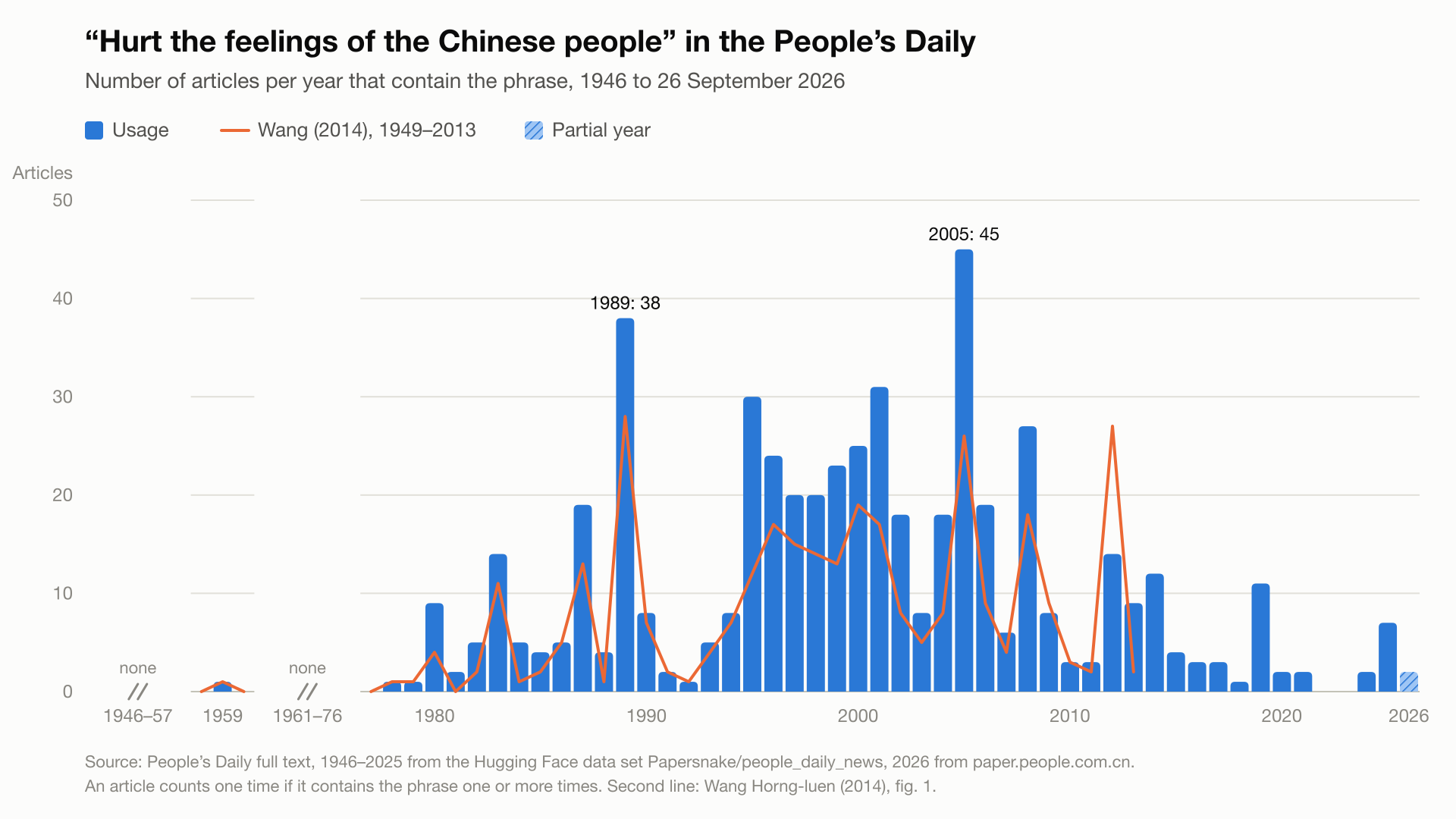
Second, here's Claude's explanation of its methodology:
When China objects to the act of a foreign government, it often says that the act "hurts the feelings of the Chinese people" (伤害中国人民感情). This project counts how often the phrase is in the People's Daily, the official newspaper of the Chinese Communist Party, from 1946 to today. The text of the paper is available: about two million articles, from a free data set up to 2025 and from the paper's website for 2026. Claude, an AI model, wrote the search and checked the results. The project owner does not read Chinese. This post tells how Claude found the phrase in these articles and how Claude checked the results.
Why a simple text search does not work
In Chinese, the base phrase has eight characters: 伤害中国人民感情. Word for word, it is "hurt – Chinese people – feelings" (伤害 – 中国人民 – 感情).
Written Chinese has no spaces between words. Also, writers often add words to the phrase or change its order. Some real examples, in English:
- "hurt(past) the feelings of the Chinese people" (伤害了中国人民的感情). Chinese adds a small word to show the past.
- "seriously hurt the feelings of the Chinese people" (严重伤害中国人民感情)
- "hurt the feelings of the 1.3 billion Chinese people" (伤害了13亿中国人民的感情)
- "hurt the national feelings of the Chinese people" (伤害中国人民的民族感情)
- "hurt the feelings of the people of China and the Asian countries" (伤害了中国和亚洲各国人民的感情)
- "the feelings of the Chinese people were hurt" (中国人民的感情受到伤害)
Each change adds or moves characters, so a search for the exact eight characters does not find these sentences. For 1989, a search for the exact phrase finds 15 articles. Claude's final search finds 38.
How the search works
The search does not look for one fixed text. It looks for a pattern: the parts of the phrase, and how far apart they can be. The pattern has three parts:
- the word "hurt" (伤害)
- a word for "the Chinese people" (中国人民)
- the word "feelings" (感情)
The parts must be in this order. Other characters can be between them: up to 16 between "hurt" and "the Chinese people", and up to 20 between "the Chinese people" and "feelings". But a gap must not contain a comma, a full stop or a similar mark. This rule keeps the three parts in one clause. Thus the search does not join words from two different sentences.
The search also finds the passive form: "the feelings of the Chinese people were hurt" (中国人民的感情受到伤害).
For "the Chinese people", the search accepts a list of words with the same meaning. Examples are "the Chinese nation" (中华民族), "the Chinese" (中国人), "the people of our country" (我国人民), "the sons and daughters of China" (中华儿女) and "the descendants of the Yellow Emperor" (炎黄子孙), a traditional name for the Chinese. It also accepts "China" (中国) followed a short distance later by "people" (人民). This finds forms such as "the people of China and the Asian countries" (中国和亚洲各国人民) and "China's 1.2 billion people" (中国12亿人民).
Before the search, all spaces and line breaks are removed, because older texts often break a line in the middle of the phrase. The search accepts both forms of Chinese characters: the simplified form used in mainland China today, and the traditional form.
An article counts one time if it contains the phrase one or more times.
Warnings
Not every match is an accusation. Some are warnings, for example "do not again do things that hurt the feelings of the Chinese people" (不要再做伤害中国人民感情的事).
To help the reader find these, the search tags a match as a possible warning when words such as "do not" (不要), "avoid" (避免) or "never" (绝不) come before it in the same clause. The tag is only a guess from these words. It does not remove the article from the count: the count includes accusations and warnings. The project owner decided this, because a database search for the phrase also finds warnings. A reader who wants only accusations can remove the tagged articles.
How Claude checked the results by hand
The first version of the search was narrower. It accepted only two words for "the Chinese people", and it permitted a shorter gap. To find what it missed, Claude also kept a wider set of matches: all sentences with "hurt … feelings" (伤害……感情) and any word about China or the nation.
Claude read 814 matches, each with the text around it, in groups of 100 to 170. Claude gave each match one label and a short reason in English. The labels were:
- accusation: the text says that an act hurts, or will hurt, the feelings of the Chinese people.
- warning: the text tells someone not to do things that hurt these feelings.
- denial: the speaker says that they will not hurt these feelings.
- other group: the phrase is about a different group, for example the people of Taiwan and the mainland together, the peoples of Asian countries, ethnic minorities inside China, or a dispute inside China.
The check found three problems in the first version:
- It missed 66 real accusations. Most used a word for "the Chinese people" that was not on the short list, or had a longer gap.
- The "possible warning" tag was often wrong. It was put on words that start with "not" but do not make a warning, such as "not hesitate to" (不惜), "disregarding" (不顾) and "unfriendly" (不友好). It was also not put on most real warnings.
- A second tag, for phrases about "the peoples of both countries" (两国人民), was put on unrelated words such as "relations between the two countries" (两国关系).
The second version of the search, described above, fixes these problems. On the matches from 1946 to September 2026:
- It finds 498 of the 501 accusations that the check found (99%).
- It finds 580 matches in total. 498 are accusations and 73 are warnings. The other 9 are denials or other uses.
- Of the 76 warnings and denials, 68 have the "possible warning" tag.
- 2 real accusations also have the tag by mistake: a rhetorical question and an "if … then it would not" (如果……就不会) sentence. The search found these 2 accusations correctly; only the tag is wrong. Because the tag does not remove an article from the count, the count is correct.
These numbers are too good. Claude used the same matches to design the second version and to test it. A fair test needs new data: for example, a person who reads Chinese labels a random sample. No person who reads Chinese has checked Claude's labels yet. Also, the check did not include sentences with no word about China, such as "hurt our feelings" (伤害了我们的感情). Some of these can be accusations.
Wang's count
The graph in the Wikipedia article "Hurting the feelings of the Chinese people" comes from a 2014 paper by Wang Horng-luen of Academia Sinica in Taiwan. He searched a People's Daily database for the exact phrase and counted 319 articles from 1949 to 2013. The paper does not tell how the database search works, or if he removed some results by hand.
The first plan was to add new years to his series. For this, Claude's search had to give the same numbers as his. Claude tested four searches on 1989 and 2012. The numbers are articles in 1989 and in 2012:
- The exact phrase (伤害中国人民感情): 15 and 5
- "hurt", "Chinese people" and "feelings" in order, with short gaps: 35 and 12
- "hurt" (伤害) anywhere, and "Chinese people('s) feelings" (中国人民(的)感情) anywhere: 29 and 14
- "hurt", "Chinese people" and "feelings" anywhere in the article: 44 and 19
- Wang: 28 and 27
No search gives both of his numbers. Thus the project did not add to his series. It makes a new series from 1946 to today, and shows his series only as a separate line.
The two counts compared
For 1949 to 2013, Claude's search finds 483 articles. If only the matches that the hand check found to be real accusations are counted, it finds 420. Wang found 319.
- Both counts find the first use in the same article, on 17 December 1959.
- Claude's count is higher than Wang's in 28 years and the same in 7 years.
- Claude's count is lower in two years: 2009 (by 1 article) and 2012 (14 articles against his 27). Claude checked all 14 articles for 2012. All are real accusations.
The cause of the 2012 difference is not known. Possibly his database also includes the overseas edition of the paper, or it matches the words separately, or it has articles that are not in the copy of the paper that this project uses.